
How much does a pitch deck cost? It's an odd budget question, because you're spending money to raise money. Spend too little and the deck can undersell a good company. Spend too much and you've used runway on slides you'll rewrite after your first few investor meetings.
This guide compares each route, what it includes, what to budget at your stage and when paying for design makes sense. For per-slide rates across every kind of presentation, start with our full guide to presentation design cost.
The short answer
The right budget depends less on your stage than on what you already have. If your story and numbers are solid, you mainly need design. If they aren't, you need help with the thinking too, and that costs more wherever you buy it.
- Templates and AI tools cost little or nothing, but the story, the layout decisions and the editing stay with you.
- Freelancers and per-slide studios design the content you bring. They're the most affordable way to a professionally designed deck.
- Agencies and full-service specialists add strategy, writing and sometimes the financial model. That's where the higher prices come from.
- Complex slides, short deadlines and extra versions push the price up on any route.
Your options and what they cost
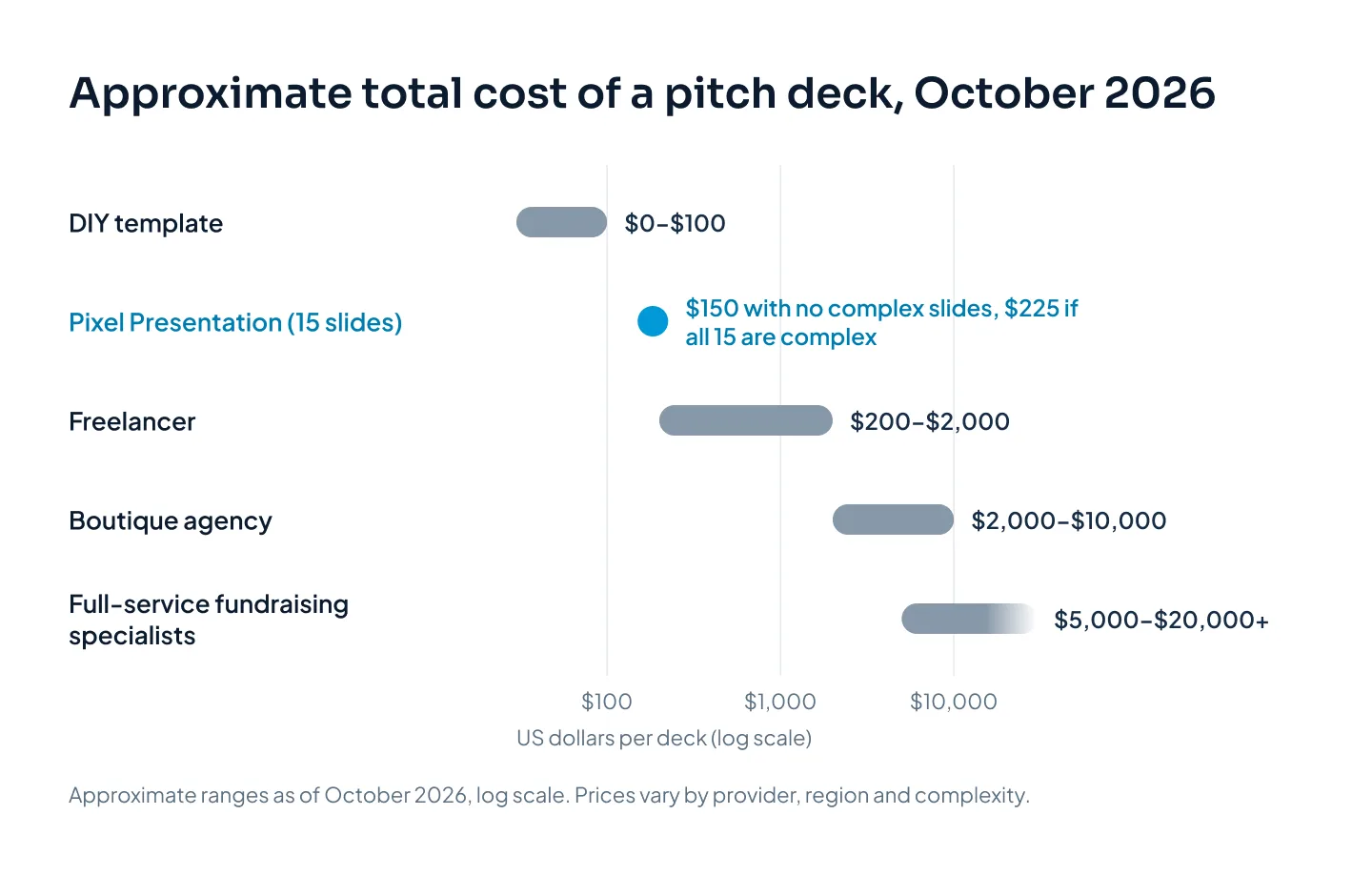
Here are the five main routes and their approximate total cost as of October 2026. Ranges vary by provider, region and complexity.
| Option | Approximate cost | Who does the work | Best for |
|---|---|---|---|
| DIY template | $0–$100 | You | Very early decks and tight budgets |
| AI presentation tool | A monthly subscription | You and the tool | A fast first draft |
| Freelancer | About $200–$2,000 | One designer | A finished story that needs designing |
| Boutique agency | About $2,000–$10,000 | A small team | A high-stakes raise with time for workshops |
| Full-service fundraising specialists | Often $5,000–$20,000+ | Strategists, writers, designers, modelers | Help with story, copy and the financial model |
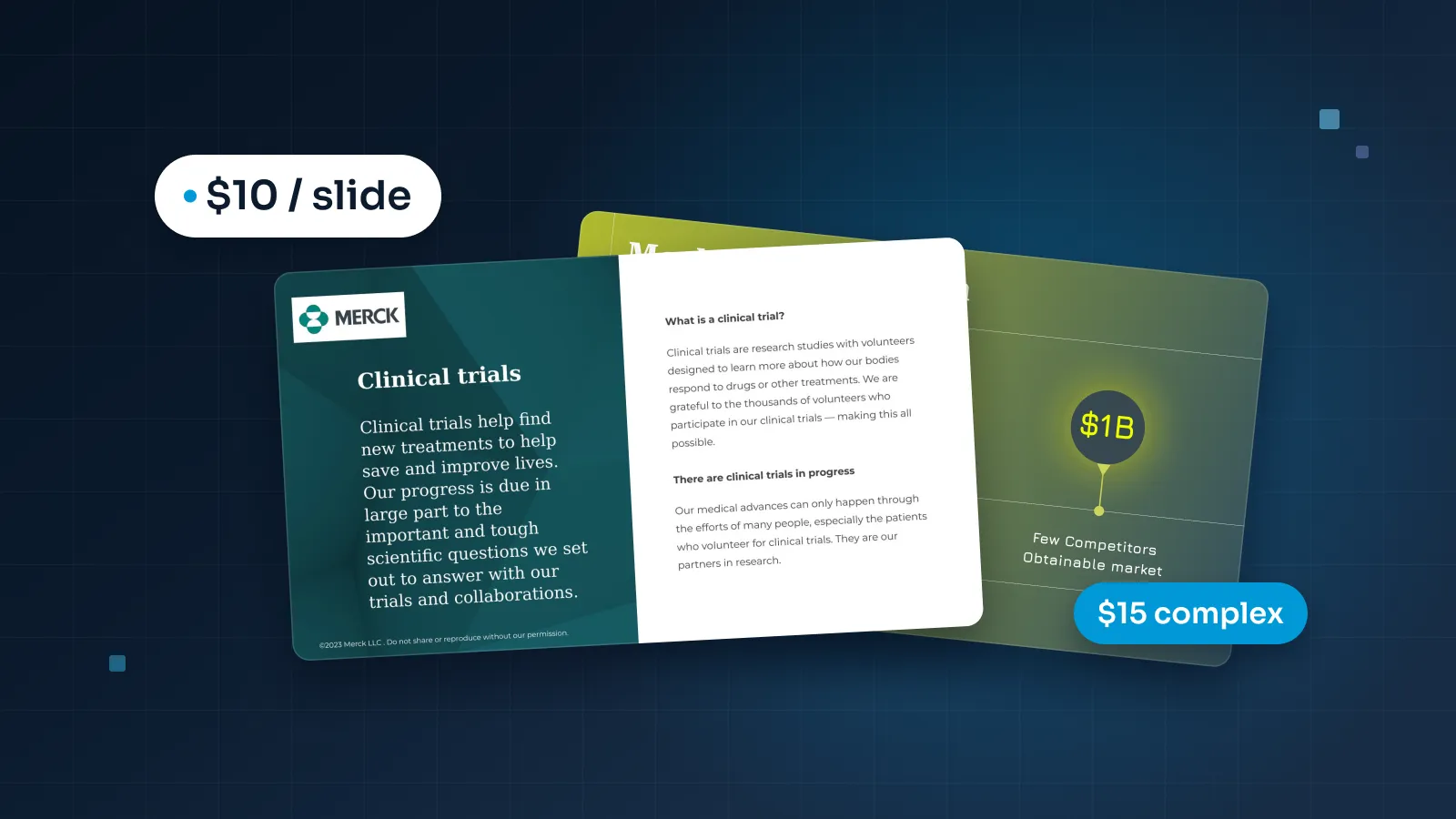
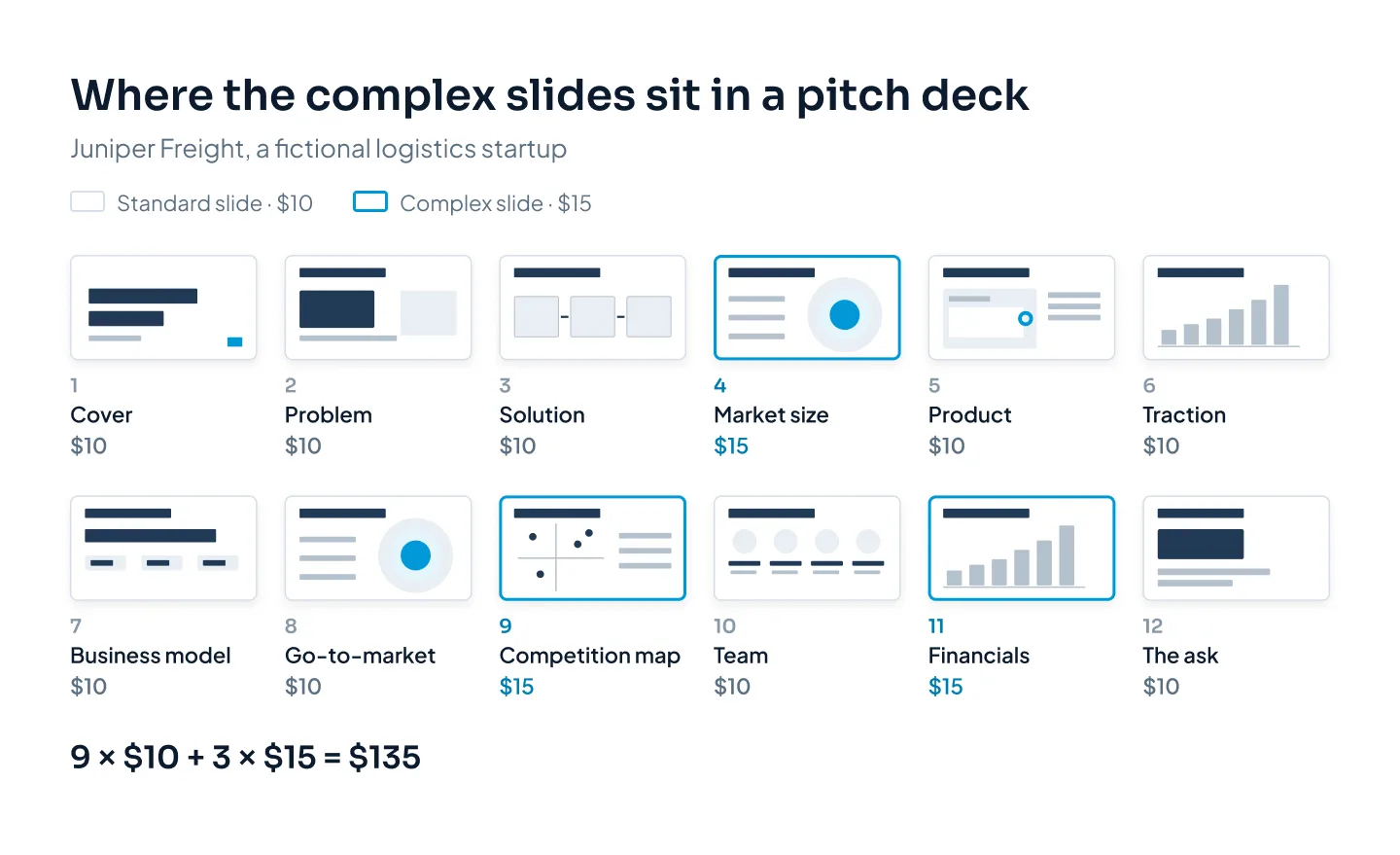
Design studios that charge per slide are another route. Ours is $10 a slide, so a 15-slide pitch deck is $150, or $150 plus $5 for each complex slide, such as a market map or a financial chart. AI tools usually come with free plans, and paid plans run roughly $10–$40 per user a month.
What's included at each price
A price only means something next to what it buys. Here's what you typically get on each route.
DIY template: $0–$100
You get a set of designed layouts and do everything else yourself. That means writing, ordering the slides and fitting your content into boxes designed for someone else's story. A template works well when the deck is early and changes every week. Pick one built on a proper slide master with editable charts, not a set of pictures.
The trap is fit. A template made for a generic startup rarely matches your story, so slides get squeezed or padded to fill the layout.
AI presentation tool: a monthly subscription
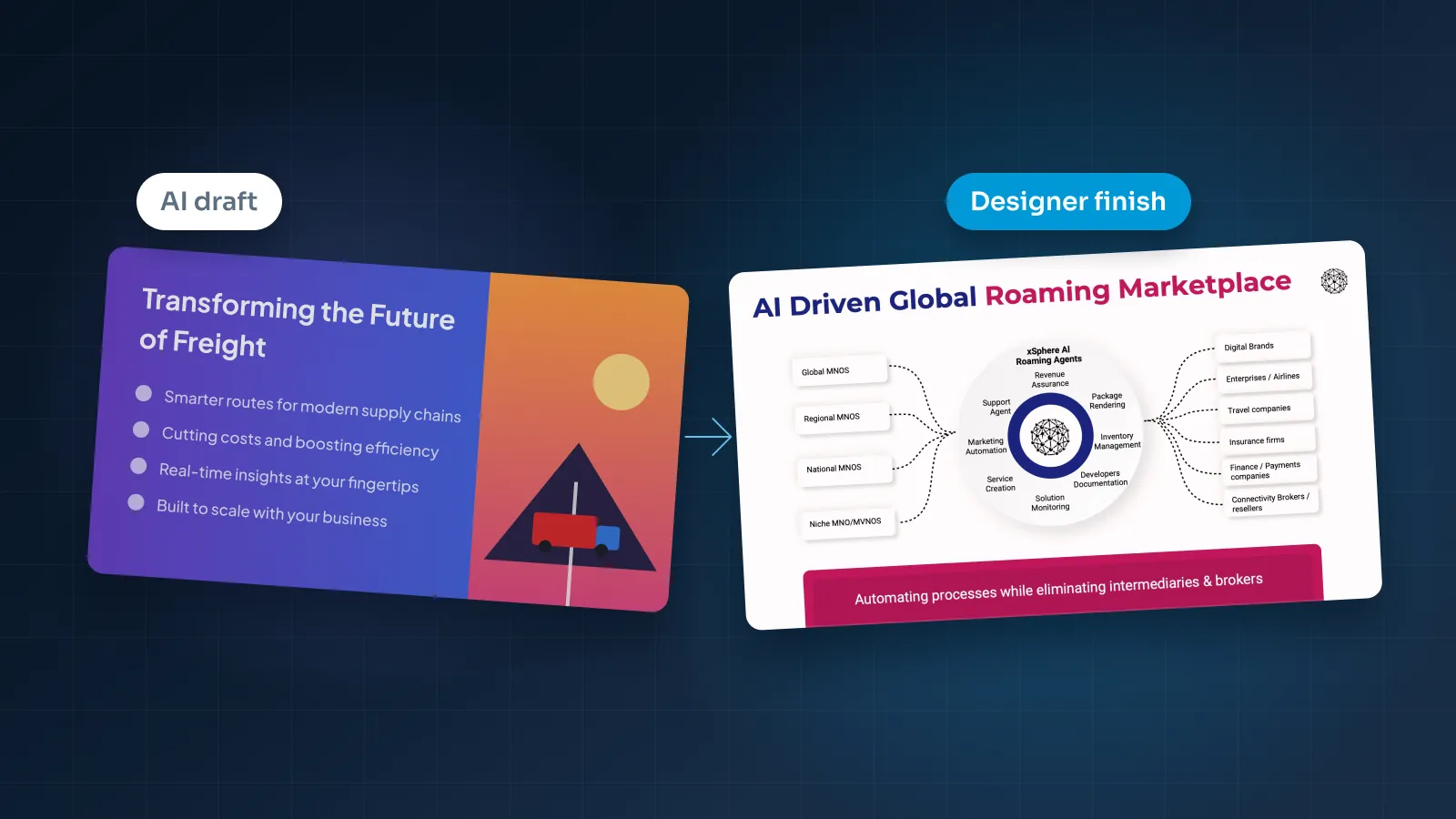
You get a full draft in minutes from a prompt or a document, and many tools export to PowerPoint or PDF. What you don't reliably get is judgment: knowing your best number belongs in the traction headline, or that the competition slide should come later.
Exported files can be harder to edit than a natively built deck, and AI decks tend to look alike. Our comparison of AI presentation makers and designers covers the trade-offs in detail.
Freelancer: about $200–$2,000
At the low end, a freelancer applies a clean design to the content you send. Toward the top, an experienced pitch deck specialist will question your structure, rebuild charts properly and suggest cuts.
Before comparing quotes, ask about revision rounds, editable source files and native charts, and whether they'll edit your copy.
Boutique agency: about $2,000–$10,000
You get a team and a process, usually with some strategy: a kickoff session, a story outline, copy editing, design and several feedback rounds. Many agencies price per project. The extra money buys time with senior people, which matters most when you're unsure what your story is.
Full-service fundraising specialists: often $5,000–$20,000+
These firms handle strategy, copywriting and the financial model as well as the design. For a technical founder with a strong product and no idea how to frame the raise, that help can be worth it. If your story and model are already done, you'd be paying for work you've finished.
A per-slide studio: $10 a slide
This is our model. You bring your content, notes or an AI draft, and our designers design every slide and check it in studio QA before you see it. Standard delivery is five working days, or 48 hours with Express, with two revision rounds included. Everything that comes with it is listed on our pitch deck design page.
You can see that approach on a real project in the Welltech Ventures investor deck, built from a wellness fund's market research with native PowerPoint charts.
What to budget at pre-seed, seed and Series A
There's no fixed price per stage. What changes from stage to stage is what the deck has to carry, and that tells you which route makes sense.
| Stage | What the deck has to do | Sensible route |
|---|---|---|
| Pre-seed | Explain the problem, the team and why now, often with little traction | DIY template, AI draft or a low-cost designer |
| Seed | Stand on its own when emailed, and hold up in a live pitch | A freelancer or per-slide studio, with budget for complex slides |
| Series A | Carry real metrics and a credible financial plan for investors who dig in | A designer if the story is sharp; an agency if it needs rethinking |
Pre-seed
Your story will change after your first few investor conversations, so don't lock a big budget into a deck you'll rewrite. Put your effort into clarity: one idea per slide, a problem a stranger can understand, a team slide that explains why you.
A template or an AI draft is fine here, as long as the result is clean and editable. If you have a small budget, a short designed deck stops the design from distracting from the idea.
Seed
This is where a designed deck usually earns its cost. You'll send it to many investors, often before you speak, so it has to read clearly without you there. Put the money into the slides that carry the most weight: traction, market and financials.
Within the ranges above, a freelancer or a per-slide studio can cover a seed deck when the story is ready. If it isn't, that's the gap an agency fills.
Series A
Investors look harder at metrics and the financial model, so data slides matter more and the appendix grows. If your team has a sharp story and clean numbers, design is still the main job, just with more complex slides. If the narrative needs rethinking, that's when boutique agencies and full-service specialists earn their higher fees.
Whatever your stage, the pitch deck guide covers which slides to include and the order that works.
What pushes the price up
- Complex slides. Market maps, financial charts and custom diagrams take longer to build than a headline and a photo. With us, a complex slide is $15 instead of $10, and you see which slides count before you order.
- Writing from scratch. If someone else writes your story, you're paying for writing time on top of design. Arriving with your content, even rough notes, keeps the cost down.
- The financial model. Building one is analyst work, not design, and it's a big reason full-service specialists cost more. Designing charts from a model you already have costs far less.
- Short deadlines. Most providers charge for speed. Our Express (48 hours) adds 25% to the design fee and Rush (24 hours) adds 50%, when a designer has the hours free.
- More versions. A version to email, a version to present and a short demo day cut each add slides to design, even when they share content.
- Animation and speaker notes. Useful for a live pitch. With us, they're $3 and $2 a slide, on the slides you choose.
- Extra revision rounds. We include two, and extra rounds are $25 each. Agree who signs off before the first round starts.
- A long main deck. Every slide costs money. Our view: usually 12–15 slides for the main deck, with an appendix for detail.
The pricing estimator adds these up for your own deck, so you can see how each choice changes the total.
Is a designed deck worth it?
A designed deck won't raise money on its own. Investors back teams, markets and traction, and no layout changes those. What design changes is how quickly and accurately a reader gets to them.
Think about how your deck gets used. Often it arrives by email ahead of a meeting and gets read without you there to explain it. Every slide has to make its point on its own. A clear hierarchy, one idea per slide and charts whose headline states the takeaway all cut the effort it takes to understand your company.
Design also signals care. A deck with mismatched fonts, stretched logos and unreadable charts invites a question about what else was rushed. That's not entirely fair, but first impressions rarely are.
Then there's your time. Days spent fighting slide layouts are days not spent on investor meetings or customers. If design isn't your strength, that time is usually better spent elsewhere.
Design makes a strong story easier to see, but it can't make a weak story strong.
A designed deck isn't worth it when the story isn't settled, when you're pitching people who already know you well, or when you're still testing whether anyone cares. A clean template or an AI draft is enough then. Spend on design once the story holds up in conversation.