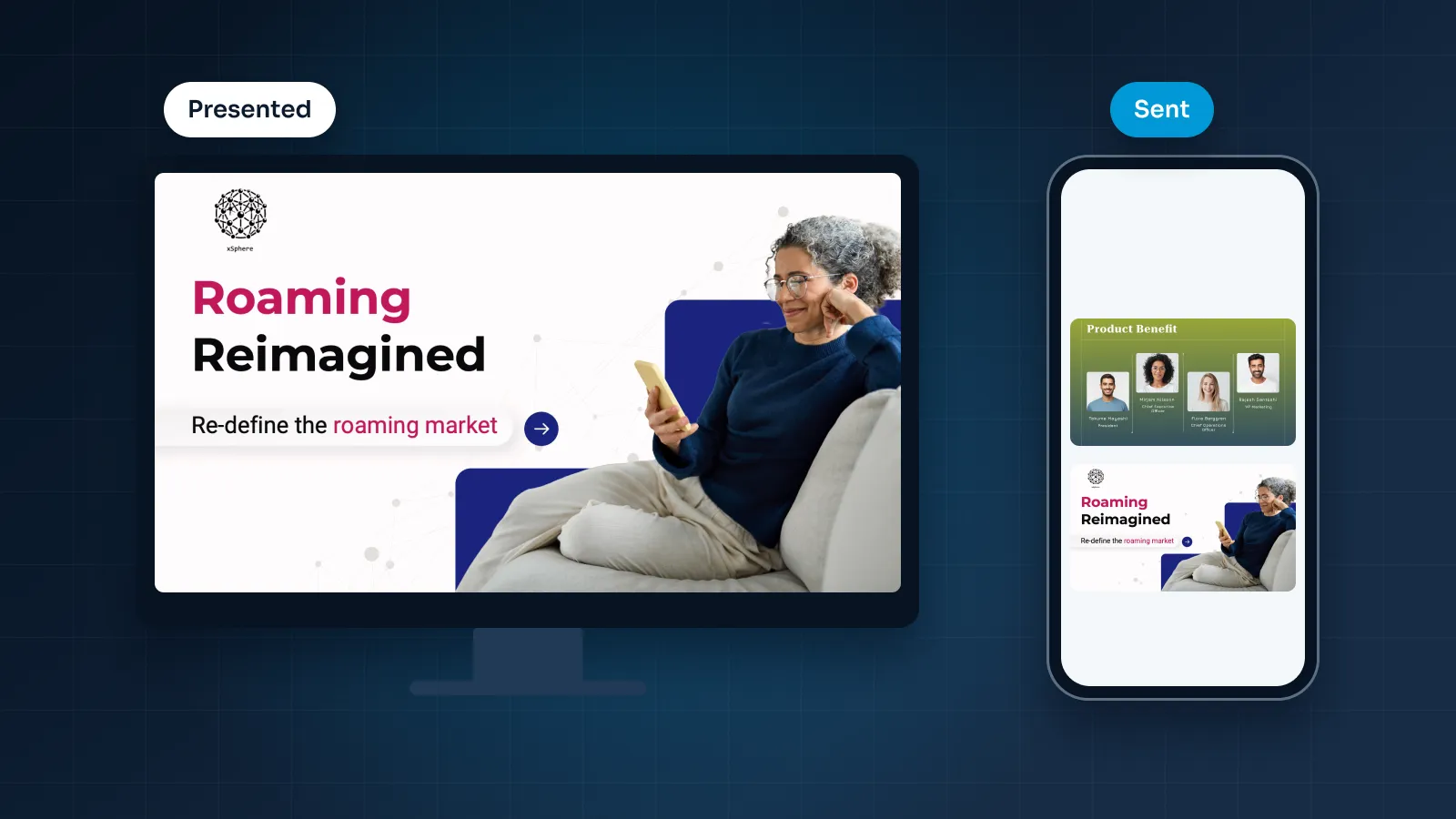
The confusion is fair. Investors, advisors and accelerators use both names, often for the same file. But a deck you present and a deck you send do different work, and a slide built for one usually fails at the other.
Below, we cover what each version is for, how they differ, and how to build both without doing the work twice. If you're still deciding which slides to include, start with our pitch deck guide.
The short answer
The useful question isn't what the deck is called. It's whether you'll be in the room when it's read.
- Pitch deck: shown on a screen while you talk. You are the narrator, so each slide carries one idea and very few words.
- Investor deck: sent before or after a meeting and read alone. The slides carry the whole argument, so they hold more words and more data.
- The names are loose. Plenty of people say "investor deck" for any fundraising deck. What matters is presented versus sent.
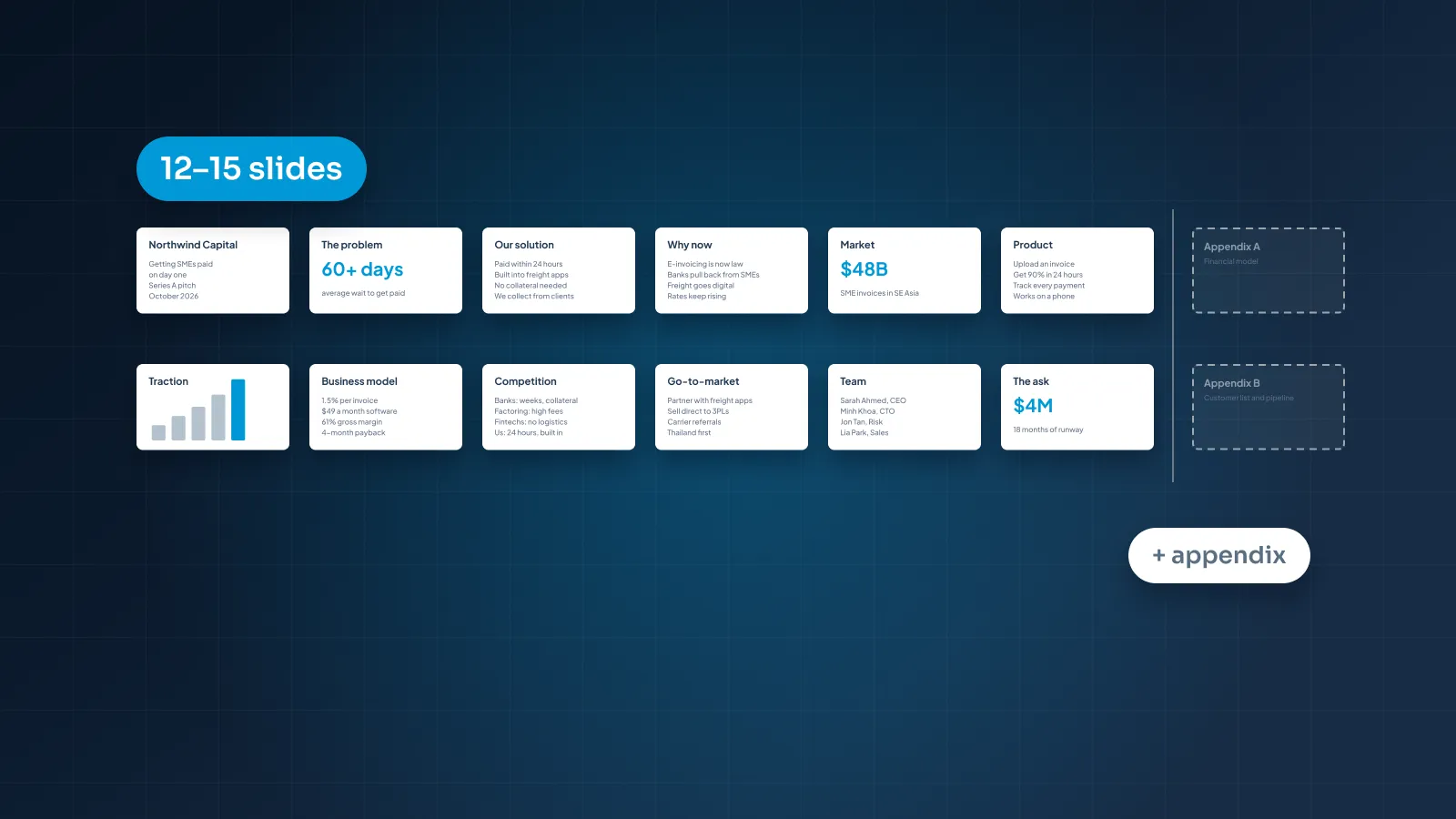
- Same story, same numbers. Both versions follow one slide order and one set of figures. Only the density and the design change.
- If you send and present, you need both. Build them from one master file, so a new number reaches both.
What a pitch deck is for
A pitch deck is the version you present: in a partner meeting, on a video call or on a demo-day stage. You're in the room or on screen, and the slides back up what you say.
Its job is to keep attention on you and make each point land as you say it. So each slide gives the audience one thing to look at: a headline, a big number, a highlighted chart or a product screenshot.
In practice, that means:
- Few words. A short headline and a handful of supporting words. If the audience is reading, they aren't listening.
- Large type. Text that reads from the back of a room, or in a small video-call window.
- One focal point per slide. The eye should know where to land straight away.
- Detail in your voice and your notes. Speaker notes appear on your screen in PowerPoint's Presenter View, not on the audience's.
The weakness shows the moment you email it. A slide that says "3x" next to a rocket icon works while you stand beside it, explaining what tripled. Alone in an inbox, it's a riddle.
Length follows your time slot. A short demo-day pitch needs far fewer slides than an hour with a partner. Our guide to how many slides a pitch deck should have breaks it down by format and stage.
What an investor deck is for
An investor deck is the version you send. It goes out before a first meeting, after a call or into a data room. It gets read on a laptop or a phone, with nobody there to answer questions. It often gets forwarded to a partner who has never met you.
Its job is to make the full case without you. Every slide has to answer the question it raises, because the reader can't ask.
In practice, that means:
- Headlines that state the point. "Traction" becomes "41 retailers pay us, up from 12 a year ago."
- A line or two of support. Enough to explain the headline, not a paragraph.
- Data that explains itself. Axes, units, dates and sources on every chart, plus definitions for terms like "active customer."
- An appendix. Financials, customer detail, product detail and team bios for the reader who wants depth.
- Contact details on the first and last slides. Whoever ends up reading it should be able to reach you.
It is still a designed deck, not a report pasted into slides. One idea per slide still applies; the sent version just uses more words to carry each idea. You'll also hear it called a send-ahead deck, a reading deck or a leave-behind.
A word on the names. In practice, both terms get used for both files, and some people say "investor deck" for any deck that raises money. Public companies also publish "investor presentations" for shareholders, which are a different kind of document.
In this post, the pitch deck is the one you present and the investor deck is the one you send. That's the distinction that changes how you build it.
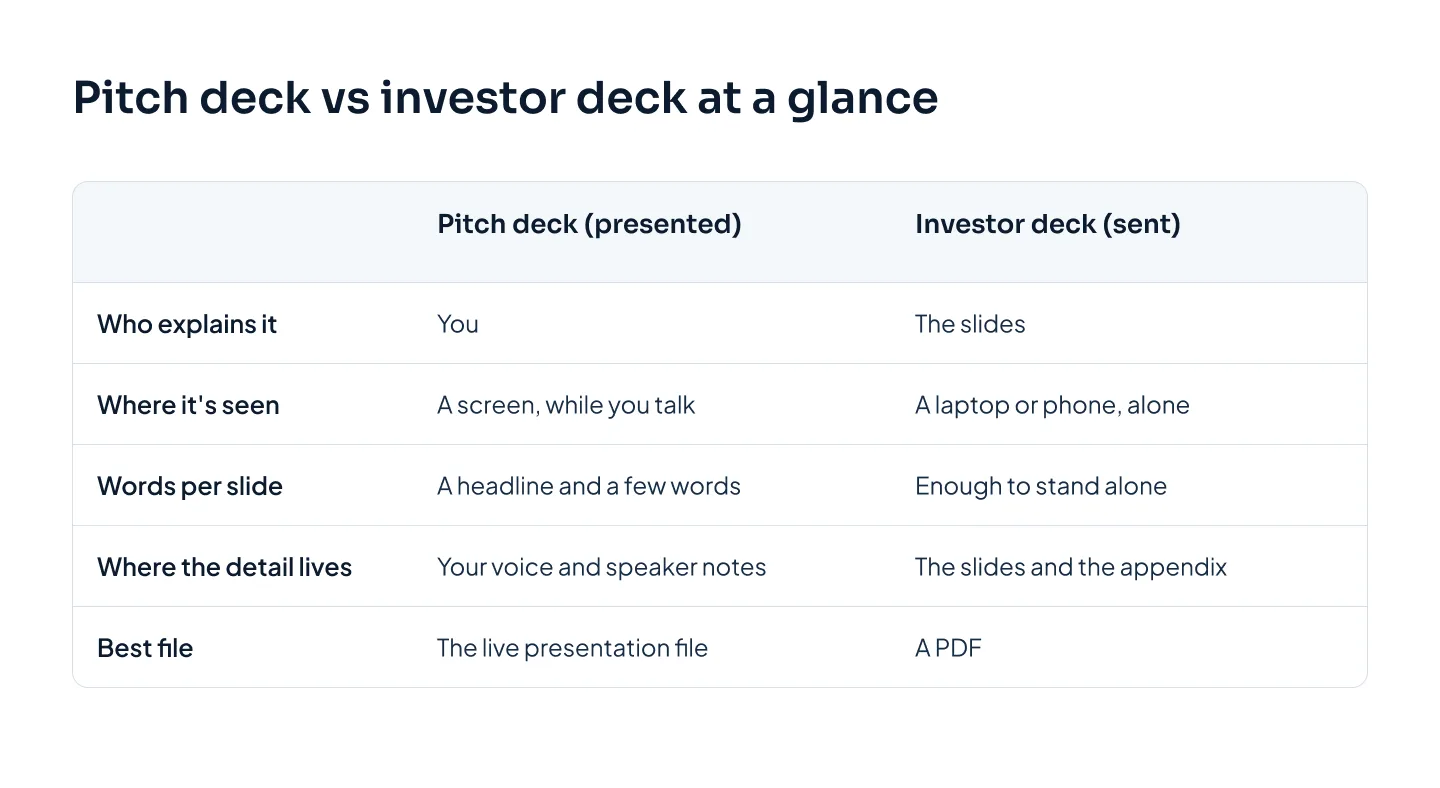
The differences side by side
| Pitch deck (presented) | Investor deck (sent) | |
|---|---|---|
| Purpose | Supports you while you talk | Makes the case without you |
| Length | Set by your time slot | Similar main deck, plus an appendix |
| Text density | A headline and a few words | Sentence headlines, short supporting text |
| Design | Large type, big visuals, one focal point | Clear hierarchy, readable on a laptop or phone |
| Data | One key number or chart per slide | Labeled charts with units, dates and sources |
| Appendix | After the closing slide, for questions | Included, for readers who want depth |
| File | The live PowerPoint, Keynote or Google Slides file | A PDF that's easy to forward |
Text density is the difference everyone notices. Data is the one founders forget. In the room you can say "that's monthly revenue since launch"; in the sent version, the chart has to say it.
Here's the same traction slide for Northlake Analytics, a fictional seed-stage startup that sells demand-forecasting software to retailers, built both ways.
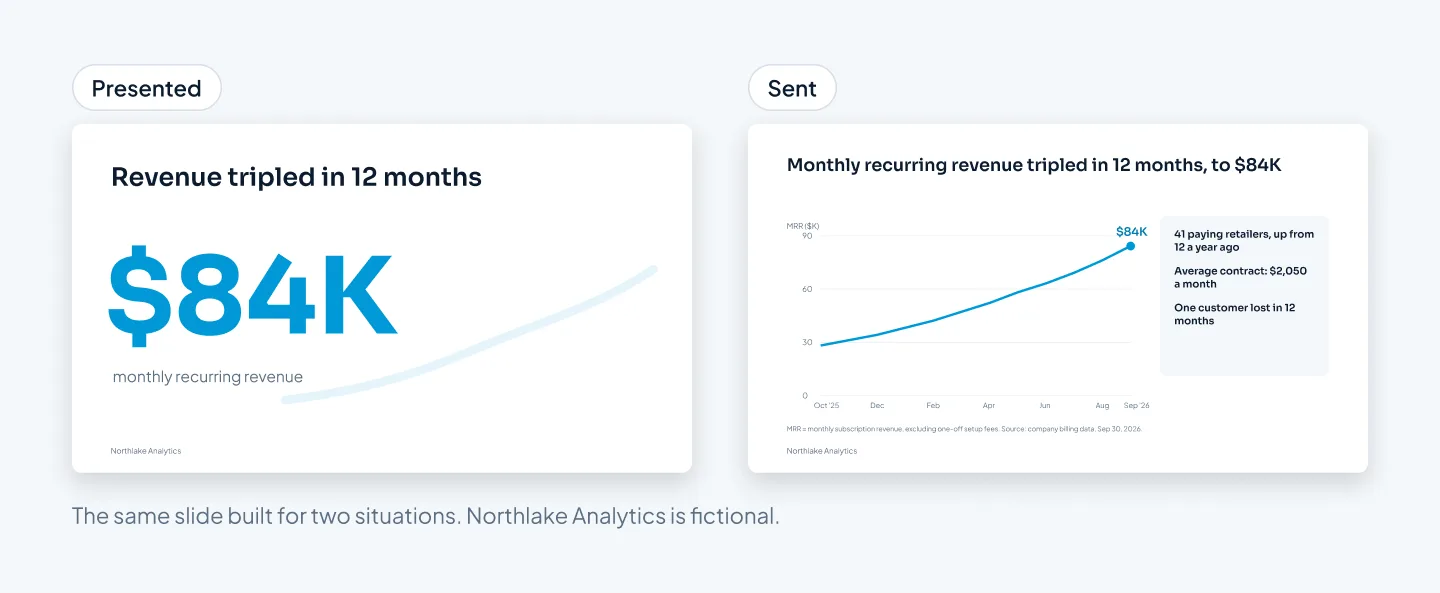
The presented version shows one number and a rising line. You say the rest: when you launched, how many retailers pay and why growth is speeding up.
The sent version states the takeaway as a full sentence and labels the chart. It adds customer count and contract size, and a footnote defines MRR (monthly recurring revenue) and its source. Same claim, same numbers, different job.
A deck you present and a deck you send are different products, even when they tell the same story.
Do you need both? Building them from one master
When you need both
If you'll send a deck before meetings and present in them too, build both. For Northlake, a round might go like this.
An investor asks for the deck after a warm intro, so the founders send the investor deck. They present the pitch deck on the first call. Afterward, they send the investor deck again, so the investor can share it with partners who weren't on the call.
When one version is enough
- You only pitch live, at a demo day or a competition. The pitch deck is the priority, though a PDF to send afterward helps.
- You only send, for cold outreach or an application form. The investor deck does the job.
- You only have time for one. Build the investor deck. Presented on a call, a sent deck is wordier than ideal but still makes sense. A pitch deck sent alone often doesn't.
How to build both from one master
- Lock the story and the numbers. One slide order, one set of figures and one source for each. The pitch deck guide covers the order.
- Build the design once. One slide master with layouts, theme fonts and colors, and chart styles. Both files use it, so they look like the same company.
- Write the sent version first. Full-sentence headlines, labeled charts, detail moved to the appendix. This is your investor deck, and your master.
- Make the pitch deck by subtraction. Duplicate the file. Cut each slide to its headline and one visual, enlarge what's left, and move the removed sentences into the speaker notes.
- Keep the numbers in sync. Use native charts, such as PowerPoint charts with their data in an embedded Excel sheet. A new month of data is then an edit, not a redraw. When a number changes, change it in both files the same day.
- Export and name clearly. Send the investor deck as a PDF with a plain file name, like
Northlake-Analytics-Investor-Deck-Oct-2026.pdf. Present the pitch deck from the editable file.
For an example of native charts in a finished deck, see the Welltech Ventures investor deck, built from market research for a wellness fund.
If you'd rather hand the build to a designer, the pitch deck design service at Pixel Presentation includes story restructuring and copy polish on every deck. A second version adds design time, so budget for it; our breakdown of what a pitch deck costs compares the options.